Showing posts with label children's books. Show all posts

Monday, July 11, 2016

Alexander Hamilton: Before We Rapped We Read

Hamilton with his nemesis Burr

Every year on January 11th, or, if that glorious day falls on a weekend, the nearest weekday, I read just one book to every class at Alexander Hamilton Elementary School, "Duel! Burr and Hamilton's Deadly War of Words", by Chicago author Dennis Brindell Fradin (sadly attempts to lure him to Hamilton School have been unsuccessful). January 11th, Hamilton's birthday, is celebrated with great gusto at his namesake school, in fact the founding father himself has visited almost every year (quite confusing to some younger children who were almost certain that he was dead).

Before there was a healthy school, there were cupcakes for every child, and a school wide birthday sing along lead by the choir or the music teacher or a willing guy with a guitar (thankfully for my children this celebratory task was never assigned to me). My self designated role on the greatest day of the year has always been to read about Hamilton and to talk about his accomplishments and his shortcomings. To remind children that while what he might be most well known for, until recently, was his tragic death, that his list of achievements is long, and often overlooked.

Three things that students are expected to know:

1. He was never, ever a President,
2. But he was the first Secretary of the Treasury, and
3. His face is on the $10 bill; one of only two men to never serve as President honored in this way.

Older students get to listen to me blather on about his leadership in the creation of our system of finance (and his advocacy for reasonable public debt), his want of a strong Federal government, his role in the compromise to unify the states and locate the new capital in northern Virginia, and his mad writing skills, most notably found in that page turner, The Federalist Papers.

We do not discuss his indiscretions, poor decision making skills or Maria Reynolds.

Talking with children about history is fun and interesting. When you create stories, rather than facts, it's engaging. Of course when you create awe inspiring musicals that sing, dance and rap the story it's even better. Teaching children history is important because some day it might be cool to know exactly who this founding father without a father really is; students at Hamilton School already do (I hope).

Kindergarten classes are spared the tragic and sad story of the duel. Conversations with young classes focus on the idea of honor and the long held belief, and hope, that Hamilton shot into the air.

July 11th marks the anniversary of the duel, fought in Weehawken, New Jersey 212 years ago. 

Books We Love to Read

Duel! Burr and Hamilton's Deadly War of Words, Dennis Brindell Fradin and Larry Day
Alexander Hamilton: The Outsider, Jean Fritz
Aaron and Alexander: The Most Famous Duel in American History, Don Brown
The Duel: The Parallel Lives of Alexander Hamilton and Aaron Burr, Judith St. George


Wednesday, July 23, 2014

Kate and Mary Read: Charlie and the Chocolate Factory

In the summer of reading, I have now enlisted my children to not only help with laundry, gardening and cooking but also writing. We all read the classic Charlie and the Chocolate Factory and over dinner, overwhelmed with their responses to my questioning in putting together thoughts on the book, I decided that they would write the essays for From Left to Write. Nine year old writing skills now far exceed nine year old cooking skills, but we're working on that.

Mary

As a five year old I always thought that getting everything would be nice, and that of course my mom and dad could, so then why wouldn't they? I saw kids my age at Target begging and screaming for a doll and they would get it. And when I tried this I got a time-out at home (and no doll). Now I am nine and by understanding the world a little better, I know that wanting (not to mention having) everything, would be a mistake of mine, for I would be bored, but most importantly I would not be a very good friend or person. In Charlie and the Chocolate Factory Veruca Salt is like this. In one part of the story she tells her parents that she wants an Oompa-Loompa and that she needs one, yet these Oompa-Loompas belong to Mr. Wonka (mother editor note, discuss owning versus working for with daughter writer). And after she screams and yells and whines they tell her maybe. So in conclusion I think that kids should get things only when they are nice about it and if it is something they need. Kids should never want everything.

Kate
After reading Roald Dahl's Charlie and the Chocolate Factory I found myself pondering a fact that I had not even thought about for a very long time: the fact that there is a gargantuan amount of children in the world that have living conditions much worse than mine. Many of these children would call something as simple as  flat screen TV a luxury and complain (actually they might not complain because they were used to it) of heat in the summer and being cold in the winter because they don't have air conditioning and heat. In my free time you'll probably find me relaxing on our back deck or deciding what to play with while rummaging through our big container of outdoor toys and sports equipment. I dont' realize how great it is that I have so many privileges very often, that is until Charlie Bucket pops into my mind again.

The other four lucky winners at Mr. Wonka's factory are described as greedy and spoiled children.  What do you think would happen if they switched places with Charlie Bucket? They probably never thought of kids like him. All four were too busy eating, chewing gum, watching television and and spoiling themselves to ever think of this. From now on I am going to try to think about this everyday.

 
My thoughts, beyond what a delightful and imaginative story this is, as enchanting now as it was when I read it so many years ago, lean to appreciation for fine lessons learned. I distinctly remember being horrified at the behavior of four of the five Golden Ticket winners when I was young; I'm happy to learn that my girls share my horror.


This post was inspired by the classic Charlie and the Chocolate Factory by Roald Dahl, which celebrates its 50th anniversary this year. To celebrate, Penguin Young Readers Group, in partnership with Dylan's Candy Bar, the world famous candy emporium, and First Book, a nonprofit social enterprise that provides books for children from low-income families, is launching a year long international celebration.

Head over to From Left to Write to learn how you and your child can have a chance to win the Golden Ticket Sweepstakes where the grand prize is a magical trip to New York City, plus much more! For every entry submitted Penguin Young Readers Group will make a donation to First Book. Then join From Left to Write on July 24th as we discuss Charlie and the Chocolate Factory. As a book club member I received a copy of the book for review purposes.


This post was inspired by the classic Charlie and the Chocolate Factory by Roald Dahl, which celebrates its 50th anniversary this year. To celebrate, Penguin Young Readers Group, in partnership with Dylan’s Candy Bar, the world-famous candy emporium, and First Book, a nonprofit social enterprise that provides books for children from low-income families, is launching a year-long international celebration.
Head over to From Left to Write to learn how you and your child can have a chance to win the Golden Ticket Sweepstakes where the grand prize is a magical trip to New York City plus much more! For every entry submitted, Penguin Young Readers Group will make a donation to First Book. Then, join From Left to Write on July 24 as we discuss Charlie and the Chocolate Factory. As a book club member, I received a copy of the book for review purposes.
- See more at: http://cupcakekellys.com/2014/07/22/charlie-chocolate-factory-ive-got-golden-ticket/#sthash.dbi3dT8o.dpuf

Monday, February 3, 2014

On My Shelf, Olive Kitteridge

The majority of what I read is dictated by outside sources. This in no way slows my need to buy books but they accumulate in stacks around our apartment, waiting patiently to be read. My husband cringes with every single addition, so certain that we are sinking into the frozen Chicago tundra below.

First on the list, books my girls read in class, to better understand what they are studying, enabling me to discuss the details of Peak's relationship with his father (Peak, by Roland Smith). Earlier this year they read Flipped, by Wendelin Van Draanen, a book I love, a book I highly recommend, as do the girls. Flipped is a wonderful jumping off place for discussions about perspective and seeing the world from another point of view.

I read books for the online book review group From Left to Write, books that are mailed to me from the publisher, my choice from two options. Next up, Prayers for the Stolen, by Jennifer Clement. Book review date is February 18th, and while I am only a few chapters in, it's an interesting and quirky book about, thus far, childhood in Mexico. Given that I stretch my biography to include a Mexican childhood, I'm fascinated.

Over break I read Eleanor and Park (Rainbow Rowell), Aristotle and Dante Discover the Secrets of the Universe (Benjamin Alire Saenz), and The Fault in Our Stars (John Green), all in an effort to keep up with the young adult books being checked out by the students at my day job, the volunteer librarian gig. If this is what is being written for, and read by, students, things are looking up. 

Last week I had exhausted my stash of obligatory book selections. Next to my bed, where it has been for over one year, sat Olive Kitteridge, (Elizabeth Strout), a book handed to me by my wonderful aunt whose opinion on books, and all matters, I respect greatly. Passages of this book were used to discuss character development in my writing group where one member, now my favorite person around the table, suggested that my writing style is similar to Elizabeth Strout's. Having only read one small part of the story, I had no idea what high praise this was. The book was begging to be read.

My children are learning to write in their fourth grade language arts class. They are being taught to build to a conflict and then work to find a resolution in their stories. They are nine and learning to use language to describe everyday events within a constricting framework, designed to teach them how to effectively tell a story. At nine they need the guidelines, the structure, to compel a reader to continue.  Elizabeth Strout sailed through this part of fourth grade and found her voice, not in the conflict, but in the words and story, with no need to tell us more than what happens in this small town on the coast of Maine, on any given day. I emailed the teacher, "can you teach my children to write like this?".

Olive Kitteridge is now forever one of my favorite characters, I miss her terribly even though I don't think I cared for her very much. Best to read it now, HBO pictures has a mini series in the works, Olive Kitteridge brought to life. I'll watch, just to check in, but I think I like her best in my head, as I see her, as Elizabeth Strout drew her so beautifully for me.

Included are several links to Amazon for the books referenced, my feeling being that Amazon is a wonderful resource for reading about and discovering new books. That said, I encourage all to  support local booksellers whenever possible, after you do your Amazon research.


Thursday, January 31, 2013

A Book Riddle

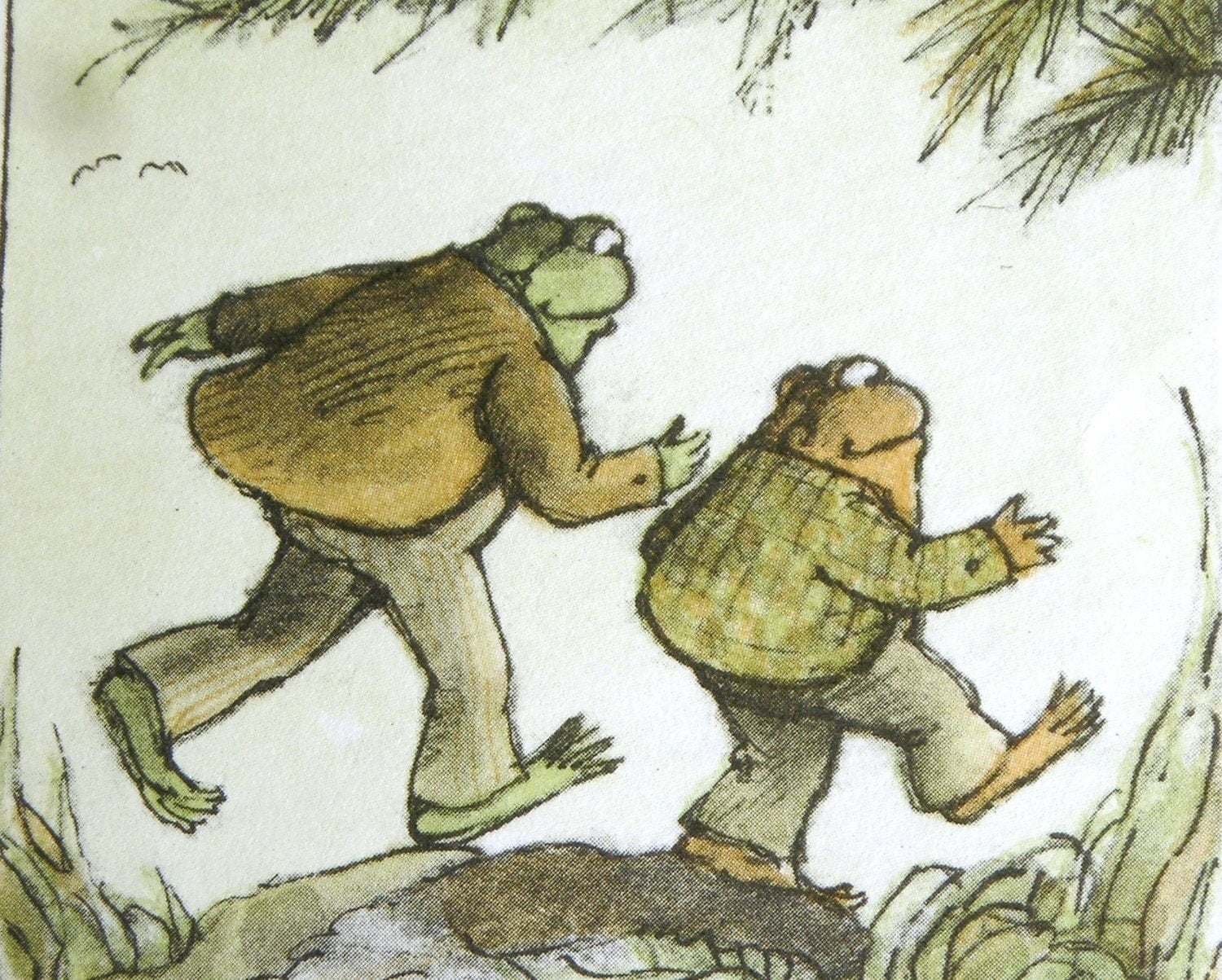
Based on one of my very favorite children's book series:

One is short, the other tall
One likes to sleep, the other not at all.
They eat cookies and ice cream,
And swim in a stream,
They have picnics on islands
Where they sit and they dream.
Sledding in winter,
Eager for spring,
Two friends together,
Amphibian and green.

-ally


Frog and Toad, Arnold Lobel

Friday, June 29, 2012

Trapped on a Full Train with Pierre, Mary and Maurice Sendak

Beep beep.

Your attention please. Your train has been delayed while the conductor steps off momentarily. We thank you for your patience.

It was 101 degrees in Chicago and only slightly cooler in the subterranean tunnel where our red line train was delayed, stuck between two stations, which ones I had no idea as I had paid no attention to where we were. I looked to Jack, across the crowded aisle, sitting with Kate, who only shrugged his shoulders.

"I have never heard this message before. The conductor got off the train? For what, a cigarette?"

The woman across from me smiled knowingly, "oh this happens all the time, really."

Really? To remove a dead body from the tracks? Or maybe to pick up some treasure he'd hidden down here, in the bowels of the city? Perhaps he was lost and stopped to ask for directions?

"No need to worry, when you ride the train all the time, as I do, these things happen", said the local.

When you ride the train all the time, as I do, the conductor stays on the train and moves me from station to station, without being told to do so. While not quite the Titanic, I still felt like maybe this guy was supposed to go down with the ship. Why leave us all here to melt in this deeply buried tunnel of malodorous humanity?

The train did not move. Usually these automated messages are followed with "your train will be moving shortly" but this one offered no such reassurance. I looked around at the 400 or so others crammed into the stuffy train car,; all in various stages of decomposition, and smell, we were a mass of sweltering bodies trapped underground on a red line train going nowhere.

But this is not a story about my paranoia, or age related claustrophobic tendencies. It's a story about Mary, Maurice Sendak and wonderful books.

After three or four minutes my cool exterior was wilting. Mary, sitting next to me, reached into my bag and dug out one of two books she knows she will always find in my bag: Pierre, by Maurice Sendak. When I began to read she said, "no Mom, let me read to you this time", and she began.


Soon she was reading, not from the pages of the well worn book, but from memory, reciting the words that had been read to her over and over, from the story that has been in my bag, next to Sendak's Chicken Soup with Rice, for as long as she knows. For years, when faced with a tired child or a long delay, anything that required a distraction from the sometimes much too big world around them, I brought out the books and we would retreat, for just a while, into Sendak's world, which proved to be a constant and comforting place to be. As it still does, for a mom growing quite nervous, abandoned in an hot and dark subway.


The moral of Pierre's story is to care; Maurice Sendak's, to create, and mine, to read to your children, because someday they might just read to you.


Pierre, A Continuous Tale, by Maurice Sendak
Chicken Soup with Rice, by Maurice Sendak

Saturday, June 9, 2012

The Family Book, in Our Library

Three years ago, when I started working in the library at school, Jack delighted in calling me Tipper. Digging through books that had not been touched in 8 years, I tossed plenty that were out of date, out of touch and some, yes, that were inappropriate. Books on the hallucinogenic properties of mushrooms, written in 1974, did not fit in our growing elementary school library. The pictures scared me, the content was, at best, disturbing, and quite out of date.

It seems I am not the only Tipper in Illinois. Erie, on the far west border of the state, has decided that Todd Parr's The Family Book is not suitable for their grade school library. The happy text and bright colors, the beautiful messages found in all his books, are just not what the good people of Erie are looking for in their book collection. Todd Parr, it seems, is promoting the gay agenda by including these words in his book: some families have two moms or two dads.

Parents in Erie were perhaps concerned that exposing children to all kinds of family was not something that should happen at the grade school level, at least not in Erie. Which is then to assume that every family in Erie consists of two married heterosexuals, and a couple of children. There must not be any single parents or families with step parents and clearly there are no children living with grandparents. Maybe that is the case, I don't know, I've never been there.

And even though I've never been there, it doesn't mean I'm not curious about what I might find. Even if every family in Erie confirms to the rigor believed to be acceptable by the school board, families in the rest of the world do not. Someday children in Erie might leave, and come to Chicago, or further, having only known the strict definition of acceptable established in their hometown. 

Giving children the opportunity to see the world in every way teaches them understanding and compassion. And showing them diversity without labels takes away the different factor. The term gay is not used in our home, no more than we refer to ourselves as straight. The Family Book introduces the idea of two dads, or two moms, without assigning a name, without drawing attention to this idea being outside of what is considered normal. It's not the only one; We All Sing With the Same Voice, a beautiful song, now book, from Sesame Street, includes: "I have sisters one, two, three. In my family there's just me. I've got one daddy I've got two". And one of my favorite books, Everywhere Babies, includes in it's illustrations pictures of same sex parents right along with those of mixed sex parents, with no distinction or attention directed at either.

Making broccoli part of the meal, rather than a  weird looking side dish that they are forced to eat, helps children develop a taste for broccoli at a young age. We don't say "eat your vegetables", we say "eat your dinner". And liking broccoli does not mean you are going to grow up to be a vegetarian.

Wonderful Books

We All Sing With the Same Voice, J. Philip Miller, Sheppard M. Greene, Paul Meisel
Everywhere Babies, Susan Meyers and Marla Frazee
The Family Book, Todd Parr
Two Eggs, Please, Sarah Weeks and Betsy Lewin

Thursday, October 20, 2011

A Book Riddle


Not Mommy or Daddy or even boo hoo
Her first words were saved for an animal,
That’s who!

She had lost him she thought
A tragic ordeal
She yelled, she went boneless, she let out a squeal.

As always it was
That Mommy knew best
And they all rushed back
Past the school, through the park, a little bird nest.


They looked high, they looked low
And found nothing soft and green
Until Daddy reached back further
To a place he had not before seen.

Trixie laughed, she screamed, they thought it was funny,
And then happily yelled out her first words,
“Knuffle Bunny!”


Knuffle Bunny, by Mo Willems, is one of Mary and Kate's favorite books. I wrote several book riddles as a game, to encourage them to listen and use clues to discover which of their favorite books I was describing.

Monday, April 11, 2011

Mary and Kate

When I turned the page my voice cracked, I had read this book many times before. Mary buried herself in my shoulder, innately sensing what she could not possibly know. This story was new, as it was to me when I read it for the first time with my grandmother, when I first sunk into her arm cradled around me. A pause, a deep breath and I continued, “I will not be going back to the barn”.

My arm brought Mary closer, and we continued. Six pages later Charlotte “summoned all her strength and waved one of her front legs at him”; Mary burrowed further into my sweater, unaware that the most difficult part was yet to come. Kate was quiet and still, I squeezed her leg and continued.

The lonely and well drawn description of the post-fair grounds has always been tortuous for me, and it was for Mary, who sobbed uncontrollably. The juxtaposition of the busy fair full of people and life with Charlotte’s quiet demise brought both of us silence, clinging to each other, not at all alone; “No one was with her when she died”.

Kate sat quietly, her lip quivering, clearly too overcome with emotion to speak. “Are you all right love?”, I asked, reaching beyond my own pain to comfort a child who needed her mother.

“I am just trying not to laugh at you two”, said Kate.

The book is, of course, Charlotte's Web, one of my very favorites, be it now or then, when I first read it years ago with my grandmother: Charlotte's Web, by E.B. White

Thursday, March 10, 2011

Happy Birthday Dr. Suess


We celebrated Dr. Suess's birthday last week. The rhyming mad man would have been 107 on Wednesday, had he not died in 1991. Silly and ridiculous, his books always make children laugh, because a "nooth gush on my toothbrush" is funny. We never read these when I was young. Brad and Kristen had them, the whole set in a bookshelf at the top of the stairs, but there were no Dr. Suess books at my house. I was always intrigued, bright pictures and silly words still appealing to a third grader, when I first discovered them.

"The more that you read, the more things you will know. The more that you learn, the more places you'll go."
— Dr. Seuss (I Can Read with My Eyes Shut)

Mary and Kate's grandmother sent them an entire set of Dr. Suess books when they were born. Perfect to read to the very young, we rhymed through Hop on Pop and One Fish Two Fish Red Fish Blue Fish, giggling as I flubbered "the ink he likes to drink is pink".

"Today you are You, that is truer than true. There is no one alive who is Youer than You."
— Dr. Seuss (Happy Birthday to You!)

Last week I read Hop on Pop, Green Eggs and Ham, and Fox in Sox in the library at school. There are more than a few ways to really destroy Tweetle Beetle Bottle Puddle Paddle Battle Muddle, done especially well when reading to big eared second grade students. And while I occasionally bore them with my history lessons hidden in children's books, Dr. Suess keeps those eyes and ears keenly tuned on the story.

"The more that you read, the more things you will know. The more that you learn, the more places you'll go."
— Dr. Seuss (I Can Read with My Eyes Shut)


My favorite Dr. Suess book is his first, And To Think That I Saw It On Mulberry Street, originally rejected by up to 43 publishers. This rhyimg reminder to value creativity and embrace imagination keeps me silly, keeps me writing, and tells a wonderful story, because an elephant and a sleigh are infinitely more interesting than a horse and a cart.

"And that is a story that no one can beat, When I say that I saw it on Mulberry Street."
-Dr. Suess (And To Think That I Saw It On Mulberry Street)

LinkWithin

Related Posts with Thumbnails